A Pigeon’s Guide to Surviving the City: Junk Food and Heavy Metal
By Jae Brooks
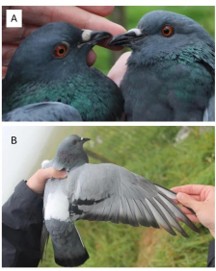 The next time you’re in a big city and see a pigeon scrounging for scraps, take a second to closely observe its feathers. You might just witness a fast-paced evolutionary shift happening in real-time.
Pigeons have undergone a dramatic change from a wild, hardy species to resourceful, city-dwelling omnivores. The original wild ancestors of all domestic and feral pigeons are Rock Doves (Columba livia), which eat grain and nest on cliff faces. By trading natural seeds, grains, and fruits in for whatever junk food they can find, urban pigeons have consequently exposed themselves to dangerous environmental hazards. However, new research indicates that the evolving morphology of feral pigeons is for survival. These changes are important to understand because it’s a great example of how human interaction can affect the genetics and physiology of urban wildlife. Unlike their ancestors who lived in largely pristine coastal habitats, the urban pigeons of today have to continuously adapt to high levels of heavy metals.

To investigate the adaptive process, researchers looked at the direct correlation between the feather color of pigeons and the amount of toxin accumulation in their bodies. Prior to this research being conducted, it had been observed that there is a larger proportion of dark colored pigeons in urban areas. The data revealed that melanin was responsible for the observed changes. As new feathers develop, heavy metals in the pigeon’s bloodstream bind with the melanin pigment and trap harmful ions within the feather. Once the feather is fully developed, its blood supply gets redirected to other parts of a bird’s body, leaving the feather ‘dead’. This process of sequestering the heavy metals essentially acts as a filter for the bloodstream and protects its internal organs from heavy metal poisoning. Research data further validates this claim by indicating that darker pigeons (those with more melanin) are better at removing and storing heavy metals than light colored pigeons (those with less melanin). This gives dark pigeons a genetic advantage for surviving in heavily polluted urban areas.
In a broader research sense, this could mean that urban environments are acting as evolutionary catalysts, forcing wildlife to adapt localized survival strategies. This implication could reshape how biologists think about the ways in which animals evolve to best suit the environment they’re in. Research is now shifting focus towards investigating if environmental-specific pollution is causing noticeable health differences between separate urban flocks. If confirmed, a broader ecological question is posed: if pigeons have evolved to use melanin to survive toxic urban environments, are there similar adaptations evolving in other urban wildlife such as squirrels or rats?