Don’t Eat That, It’s an Aerogel!
By Emily Pax
 You may be thinking, “What’s an aerogel?”. Well, you’ve come to the right place. And trust me, it’s not the jiggly, sweet Jello® that we all know and love. You might not want to eat that, as it may’ve been made with lanthanide oxides like those shown to the left. An aerogel is highly porous, yet rigid in structure. Here’s how aerogels differ from a normal gel: whereas a normal gel has moisture, an aerogel does not. Instead, where the moisture normally is, it’s just empty space.
But how did aerogels come to be? Well, a chemist named Samuel Kistler created the first aerogel. It’s unknown exactly when he created it, but his results were published in an edition of Nature on May 16, 1931. Apparently, he did it for a bet. Yeah. It seems some of the best discoveries come from making silly bets, I suppose. He and a colleague allegedly made a bet whether it was possible to replace all the liquid in some jelly while not shrinking the jelly itself. So, Kistler ended up using something called supercritical drying to make his aerogel. Basically, how this works is the gel is placed in conditions of increasing temperature and pressure. Then, pressure is reduced, which results in the vaporization of the liquid inside while retaining the solid’s porous structure. And thus, an aerogel is made. Sounds simple, right? Well, as with most things, this was easier said than done. At the time, the manu facturing process was expensive, laborious, required the use of toxic compounds, and could even pose an explosion risk. Hence, his invention was forgotten for 30 years. Kistler passed away on November 6, 1975 in Salt Lake City, Utah. And sadly, not too long afterwards, aerogels gained more attention. A group of French scientists were able to develop a safer and more efficient way to manufacture them.
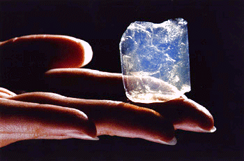 Over the years, aerogel production has advanced. Now, aerogels can be produced to have very small pores (less than 100 nm in size!) and close to 99.8% of the space within them empty. Isn’t that insane? They can be made with a combination of metals with things like silica, transition metal oxides, lanthanide actinide metal oxides, some main group metal oxides, organic and biological polymers, semiconductor nanostructures, carbon, and carbon nanotubes. They can also be reinforced with polymers or embedded with magnetic nanoparticles. They’re still made using relatively the same process that Kistler used in times of old, but the process can vary based on what type of aerogel you’re making. There are now many types of aerogels, including silica aerogels, metal oxide aerogels, organic and carbon aerogels, semiconducting metal chalcogenide aerogels, carbon nanotube aerogels, metal aerogels, and more. The image above on the left is of a silica aerogel. Isn’t it pretty? It almost reminds me of moonstone. But unlike moonstone, this can weigh 4 times less than an equivalent volume of dry air. Isn’t that crazy? Perhaps more interesting are those made with carbon nanotubes. Carbon nanotubes are seamless tubes of carbon atoms that can be used in cancer therapies as either a drug delivery system or a means of blowing up cancerous cells! To blow them up, they’re heated with radio waves. They can also be used for MEMS devices, to improve the conductivity of plastics, as sensors for biomolecules, and more. Why am I mentioning carbon nanotubes? Well, aerogels can help catalyze their growth or even be made of them! Carbon nanotubes can be grown on carbon aerogels, and aerogels made with these nanotubes have astonishingly high electrical conductivities despite their low densities. This allows for an electrical conductor with a high surface area that has high conductivity.
 NASA has used aerogels to provide insulation on a Mars rover, and their Stardust mission used aerogels to capture comet particles and interstellar dust specks without damaging them! They’re also used commercially as pellets or made into a composite with other materials. They’ve even been used to create insulating blankets and food packaging. They’ve also been used in water treatment and environmental applications. In recent developments, aerogels are finding a lot more uses. Those made with biological polymers can be used to aid in drug delivery, wound healing, regenerative medicine, and more. Aerogels are also finding more electrical applications, such as to store energy in supercapacitors and as a component of rechargeable batteries. And now, they can be used to help clean up oil spills. Heck, they’re even appearing in sunscreens to protect against UV light. So, could there be aerogels in your sunscreen? Maybe. Are there aerogels in your phone battery? Potentially. Aerogels may very well soon be, or already are, a part of your day-to-day life and you might not even know it.