
The Role of Cold Fronts
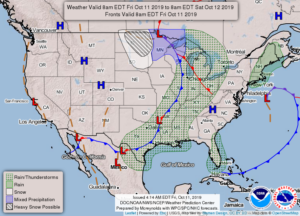
Cold fronts are one of the most common reasons for sudden weather changes. A cold front forms when a mass of colder air moves into an area occupied by warmer air. As the colder air pushes underneath the warmer air, the warm air is forced upward. On a radar like above, they are depicted by a blue line with triangles.
This rising air can create clouds and precipitation. Depending on the conditions, a cold front can bring anything from a few rain showers to thunderstorms and strong winds. Once the front passes, temperatures can drop quickly and skies may begin to clear. This is why you might experience warm temperatures and sunshine in the morning but cooler, windy weather by the afternoon.
Why Indiana Can Be Especially Unpredictable
Indiana’s location in the central United States also plays a role. The state is far enough to the north to receive that cold air from Canada and is also far enough south to receive the warm air from the Gulf of Mexico. There are also no major mountain ranges blocking these air masses from moving across the region.
Because of this, Indiana can experience large temperature changes throughout the year. This is especially noticeable during the spring and fall, when the atmosphere is transitioning between seasons.
For example, a warm day in October does not necessarily mean that warm weather is going to continue. A cold front moving through the area can quickly replace the warm air with much colder air.
The Jet Stream
Another factor is the jet stream, a narrow band of strong winds high in the atmosphere. The jet stream helps guide large weather systems across the United States.
When the jet stream shifts, it can help move different weather systems into an area. This can contribute to changes in temperature, precipitation, and wind from one day to the next.
The Jet Stream is one reason weather patterns can sometimes seem to change without much warning. A shift in its position can allow warm or cold air to move into a region.
Why Weather Forecasts Can Change
Even with modern forecasting technology, predicting exactly when weather will change can be difficult. Meteorologists use computer models, satellites, radar, weather stations, and other observations to track the atmosphere. However, the atmosphere is constantly changing, and small differences can affect what happens later.
This is why a forecast several days in advance can look different as the day gets closer. As new information becomes available, meteorologists can update their forecasts.
So the next time you see a forecast change from warm and sunny to cool and rainy, remember that there is a lot happening in the atmosphere. Weather can change quickly because different air masses, fronts, the jet stream, and other atmospheric processes are constantly interacting.
For Indiana residents, that means it is always a good idea to check the forecast before heading out- especially during the spring and fall.
By Tyler Murray